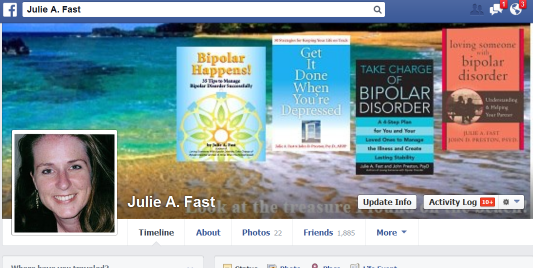
 I just posted some great bipolar disorder management tips on my Facebook page. You can find me at Julie A. Fast. Please note that I don’t use my fan page for posting.
Julie
|
|
|
|
Julie  - (Comments are closed) - (Comments are closed) Bipolar Disorder Help One thing I’ve learned since my diagnosis in 1995 is that people simply don’t know what to do when faced with someone who struggles with bipolar disorder. This includes the people who love you very much. Helping others isn’t innate for most people. This is certainly true when it comes to bipolar disorder! The solution? Teach others exactly what you need. Tell them when you’re well exactly what they can do to help when you’re ill – and they won’t feel so helpless! How to Ask for Help Everyone in my life knows about my daily struggles with bipolar disorder. It’s tough to let people know you are vulnerable and need their help, but if you let them know exactly how they can help you, it’s not such a burden to them. Have you asked for help from friends and family lately? Do you need to share with someone about how this illness affects your life? I recently met a new friend who just happened to have bipolar disorder. What a difference it makes to be able to talk with her. It is such a comfort to say, “I’m sick today,” and know that she understands. She manages the illness with lithium, so she is a good example for me, especially when my lithium is making me ill. On the other side, I have some people in my life who don’t want to help when I’m sick. I have to respect that and let them have their own lives. When I do meet someone who wants to help, I give them specific tools they can use when they see that I’m down or hypomanic. For example, everyone knows that I isolate myself when depressed. If they don’t hear from me for awhile, it’s a sign I’m depressed. They know that getting me out of the house is the answer. I’ve told them this specifically. Many think that leaving me alone is the best thing as they don’t want to bother me. I had to tell them exactly what they could do instead of leaving me alone. Call and set a time for us to meet for happy hour. Suggest a movie and give me a specific time to meet. Ask me if I’m depressed and if I want to get out of the house. I will always say yes if prompted! It’s hard for me to do it on my own sometimes. This works! They don’t feel helpless- and it saves my relationships as people can get involved in my life no matter what mood I’m experiencing! Julie
- (Comments are closed)
Over four years ago, I started coaching partners and family members of people with bipolar disorder as an addition to my writing career. I never, ever thought I would find work that I enjoy as much as I enjoy coaching. I feel at home with the parents and partners as I have been where they are- and I remain calm during the crises that many of my clients are going through while we are working together. Bipolar disorder is like a puzzle. It’s not always easy to find the right pieces on your own. It helps to have a coach as a guide. My coaching practice has room for new clients. I take new clients about once a month-and then help them as best I can. It’s a partnership that saves relationships and often lives. Coaching is not for everyone, but if you are concerned about your relationship with a person with bipolar disorder, it may be a good fit for you. The following link will tell you more. I look forward to talking. Julie Fast Family and Partner Coaching Julie
Hospitals Can Really Help It’s important to remember that hospitals are often a good place for people with bipolar disorder. Many people hear the words, You have bipolar disorder, for the first time when they are in the hospital. It’s a safe place to get such life changing news. I know this is how it was for me. My partner Ivan went into the hospital in 1994 before I had any idea of what bipolar disorder really meant. He was diagnosed with bipolar disorder I (one). The next year I was diagnosed with bipolar disorder II (two) and spent time in a hospital day program in Seattle. So many people see the hospital as a bad place- I see it as a healing place for those of us with this illness. Of course, our goal is to create a plan so we do not have to go back, but a stay at the hospital is nothing to be ashamed of. I have to remind myself of this when I get really sick. I don’t want to go to the hospital. Like many people, I see it as failure! I astonish myself with my OWN stupidity. Bipolar disorder doesn’t care how smart you are or how well prepared you are to manage the illness, it can still hit you like a sack of bricks and you have to get professional help. It’s an illness and hospitals are often the only safe place when the mood swings are raging! Julie This is St. Remy where Van Gogh stayed while under treatment from his amazing psychiatrist Dr. Gachet.
- (Comments are closed)
How I Get Things Done When I’m Depressed Bipolar depression saps my will to get things done. I remember being so depressed I cried because it felt too overwhelming to tie my shoes. I desperately needed help, but there was very little on the market in 1995 for people just diagnosed with rapid cycling bipolar two, so I made my own bipolar depression action plan. Here’s what I do: Click here to read the full blog! I love Bp Magazine. It’s under $20 a year and is great for anyone who has a connection with bipolar disorder. I’m always open to sending a subscription to a doctor’s office. If you have a specific office in mind, please write bp @ speakeasy.net with the words ‘bp mag in office’ in the subject line and I will be in touch! Please leave your comments on the blog. Thousands of people get help from what others write. You can make a difference! Julie
http://www.bphope.com/bphopeblog/post/How-I-Get-Things-Done-When-Ie28099m-Depressed.aspx I woke up feeling ok this morning. I am very much looking forward to watching soccer with my friends. (It’s the Champion’s League game with Arsenal and Borussia Dortmund for any football fans out there!) I have my morning planned out so that I can get my work done before and after the match. The weather is nice and I actually got to sleep rather easily last night! All good stuff. Then, as I was walking to Starbucks where I am doing my email, I started to have these thoughts: “Something is not right. I am in the wrong place. My clothes look funny. I am not as great as I think I am. Things will not work out for me. Other people have it so much easier. Something is wrong.” If you have bipolar disorder, you know that these quick mood swings can be actual thoughts that you can identify- or they are simply the feeling that something’s wrong. You just don’t feel right. As soon as this started, I used the tips I talk about in my books and did the following. 1. Reminded myself that I always have these thoughts when I am in a new situation such as going to a noisy place to watch a soccer game. It’s just stress and the thoughts are ALWAYS the same no matter what the event. I have them written specifically on my Health Cards so I won’t forget how normal the thoughts are for me. The Health Cards are my treatment plan- there is a link on the menu to read more. 2. I said LEAVE ME ALONE to the thoughts over and over again and just pushed the thoughts from my head. I was fine when I woke up- so I knew I could make sure this was just a blip on my day. 3. I kept going with my plan which was to go to Starbucks and do my email before I watch the match. I know that I can get things done no matter what my mind is thinking- this is mild stuff compared to what I have been through and I will not let it ruin my morning! Julie
- (Comments are closed) |
Listen to Julie’s latest interview on bipolar disorder and mental health in children, teens and adults on the Mom Brain Podcast with Hilaria Baldwin and Daphne Oz.
|
|
The health information contained herein is provided for general education purposes only. This site should not be seen as a substitute for an official diagnosis or for professional health care. Copyright © 2026 Julie A. Fast - All Rights Reserved - Site by Emanuel Sferios Powered by WordPress & Atahualpa |
|